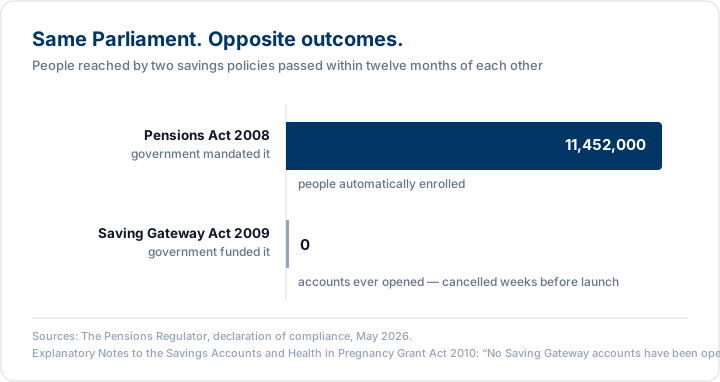
Two savings policies, same Parliament, opposite fates.
The Saving Gateway Accounts Act received Royal Assent on 2 July 2009: 50p from government for every £1 a low earner saved, up to £25 a month for two years.1 It had been through two pilots and roughly 23,000 accounts.2 Accounts were to open in July 2010. They never did, the scheme was cancelled in the Budget of 22 June 2010, weeks before launch, on affordability grounds. The explanatory notes to the repealing Act record it in six words: “No Saving Gateway accounts have been opened.”3
The Pensions Act 2008 required every employer to enrol staff into a pension automatically.4 Participation among eligible employees went from 55% in 2012 to 90% in 2025, 22.6 million people saving, with £166bn a year now flowing into workplace pensions, £63.5bn more in real terms than in 2012. Opt-out has never risen above about 12%.5
Same evidence base. Same behavioural insight. The only variable was the government’s role. In one it was the funder, and austerity killed it. In the other it was the rule-maker, the cost sat with employers and employees, so there was nothing to cancel.
That is the most important finding in British savings policy, and we have spent fifteen years ignoring it. We keep designing financial inclusion so government has to contribute the money. That turns every decision into a spending decision. So the decision never comes, and the waiting is where the money goes.
What the waiting costs
Between November 2022 and 31 August 2024, Fair4All Finance ran the No Interest Loan Scheme through seven lenders, five of them credit unions.6
To do it, it needed lending capital from three governments, a Treasury-backed guarantee covering 80% of lender losses, a subsidy scheme,7 and a separate 42-month contract with PwC to evaluate the whole thing, money spent studying the pilot rather than lending through it, advertised at between £200,000 and £880,000.8 For all that machinery it issued 14,175 loans averaging £755.9
Count the money that doesn’t come back, a Treasury grant of up to £3.8m,10 JPMorgan’s £1.2m,11 and £1.58m of bad debt charged under the guarantee12, and it cost around £464 to put £755 in someone’s hands, before a penny of evaluation.13 That’s a floor: lender set-up fees, Fair4All Finance’s own administration and the evaluation itself have never been separately published, for any year.
Look harder at the bad debt, because it asks a question nobody wanted to. That £1.58m was charged under a guarantee covering only 80% of lender losses, so real losses ran higher, on around £10.7m lent. Roughly one pound in six went bad on interest-free loans. And 86% of borrowers were in full-time work, borrowing mostly for household essentials and utility bills.14
The pilot reached for credit. The repayment data asks whether credit was the right tool. People in full-time work, borrowing at 0% for a washing machine or an energy bill, and one in six still couldn’t repay it, that looks less like a shortage of credit than a shortage of savings. Nobody tested the alternative.
Two years after lending stopped, there’s still no verdict. PwC was contracted to determine, in the Treasury’s own words, “whether NILS is a viable and sustainable product that should be made permanently available.”15 That determination doesn’t exist. The one published evaluation covers data to 31 December 2023, roughly the first quarter of the loan book; rests on 308 survey responses at a 9% response rate; has no comparison group, the counterfactual written in the future tense for a final report that hasn’t come; gives no cost per loan; and states that whether outcomes outweigh costs is “not covered by this report.”16 The Financial Inclusion Strategy, published fifteen months after lending ended, doesn’t name the scheme once.17
Five credit unions ran this. They hold every piece of front-line insight the evaluation was trying to buy. Nobody paid them to produce it.
Complexity is what you commission when you can’t decide
Innovate UK’s own framework says a detailed external evaluation should cost 1-5% of programme budget.18 The NILS evaluation was advertised at up to 8.2% of the value lent, and produced no answer.
The National Audit Office found central government spending roughly £1.36bn a year on consultants and, in its words, “does not collect data on how it uses consultants, only what it spends.” It found knowledge transfer routinely skipped, left to the end of engagements when everyone has moved on. Australia and France require knowledge-transfer clauses in every engagement; the UK withdrew its central consultancy spending controls in 2023.19
So why does a country with a savings problem keep paying large consultancies to study it? Because a study is what you buy when you aren’t ready to decide. Every guarantee, working group, pilot and evaluation is another month in which nobody has to say yes or no, and another invoice.
The same government does this properly elsewhere. Innovate UK’s Contracts for Innovation programme is running right now, with live 2026 competitions: it publishes a problem, funds at least two suppliers per phase, and the challenge owner decides who proceeds.20 Its published benefit-cost ratio is 1.53 to 4.07.21 Reporting is a payment condition, quarterly reports to a monitoring officer, impact data within 20 days on request, records kept ten years. Fail the assurance checks and your claim isn’t validated. No report, no money.22
Financial inclusion has drawn down £145m of dormant assets since 2019, of which £85m has actually been deployed, with a further £132.5m committed.23 What has never been published is a cost per outcome. Fair4All Finance reports volume, 238,000 loans in 2025, 41% growth on the year, alongside a single commissioned social-value ratio for one investee.24 The Oversight Trust’s 2023 review found that “none of our external interviewees… could offer a clear and compelling definition of what successful impact would look like for Fair4All Finance.”25 DCMS’s own statutory review to Parliament concedes it “is undertaking work to strengthen the evidence base around the Scheme’s performance and impact.”26 The NAO audits Reclaim Fund Ltd’s accounts and certifies the money was spent as Parliament intended, but has never published a value-for-money study of what it achieved.27
It’s happening again, right now
Nest Insight randomised over 7,400 employees at two large employers into opt-in, opt-out and active choice. Participation went from 15% under opt-in to 68% under opt-out. The default reached exactly the right people: 83% of opt-out savers had no £1,000 buffer, against 68% of those who volunteered.28
That’s a randomised controlled trial with Harvard and Yale co-authors, published as an NBER working paper29, a better evidence base than auto-enrolment had when Parliament legislated in 2008.
On 27 August 2025 the FCA confirmed opt-in schemes work under existing rules, but that opt-out “will likely require action from various authorities, including possible changes to legislation.”30 Ten weeks later the Strategy quoted the opt-out evidence approvingly and committed to regulatory clarity for opt-in schemes and a voluntary National Coalition of Employers.31 It chose the option requiring no decision. About 7% of UK employers offer a workplace savings scheme at all.32 The Treasury Committee’s July 2026 report made no recommendation on savings whatsoever.33
Meanwhile the dial doesn’t move. Ten per cent of UK adults have no savings at all; another twenty per cent have under £1,000, the Treasury’s own figures.34 Use of high-cost credit rose from 5.3% to 6.4% of adults between 2022 and 2024.35
Design it around how people actually behave
So: opt-out payroll saving, targeting £1,000 in everyone’s back pocket. Pay half the incentive up front, at account opening. Lock the funds until the saver reaches £500. Release the other half at £1,000, when the money is theirs.
Every element of that shape comes from the behavioural literature.
Pay half up front, because progress motivates more than promise. Nunes and Drèze’s endowed progress effect showed that reframing a task as one already part-completed “increases the likelihood of task completion and decreases completion time.” The mechanism matters for how you present it: the effect works through the perception of progress already made, not through fear of wasting the advance.36 Frame the first half as ground already covered, not money at risk.
Bring the reward forward rather than making it bigger. Woolley and Fishbach found that earlier rewards raised motivation independently of the reward’s magnitude.37 You don’t need a larger incentive. You need a sooner one, which is also cheaper.
Give them a milestone, then a round number. Kivetz, Urminsky and Zheng found people accelerate as a goal comes into view: café customers given artificial progress completed the same ten purchases in 12.7 days against 15.6, about 20% faster.38 Pope and Simonsohn showed round numbers act as reference points people exert effort to clear.39 £500 then £1,000 is a milestone followed by a round number, and £1,000 is where the protective effect sits. StepChange’s analysis of ONS Wealth and Assets Survey data found that for a household on £25,000, holding £1,000 in cash savings is associated with 44% lower odds of problem debt, and that getting there would take roughly 500,000 households out of problem-debt risk.40
The lock is a feature, not a barrier. Beshears, Choi, Harris, Laibson, Madrian and Sakong ran a US experiment offering savers commitment accounts carrying different early-withdrawal penalties. Holding interest rates equal, higher penalties attracted more deposits, not fewer, people who know their future self will raid the pot will pay for a device that stops them.41
And resist every instinct to bolt things on. No financial capability module, no coaching wrapper, no education programme. The largest meta-analysis in the field, 168 papers covering 201 studies, found interventions to improve financial literacy explain 0.1% of the variance in financial behaviour, with weaker effects in low-income samples and negligible effects beyond 20 months.42 Education layers are expensive, get poor take-up, and are how a simple default becomes a £464-a-loan programme. Auto-enrolment worked because it asked people to do nothing.
The genuine risk sits at the £500 gate. Kivetz also found effort resets to a lower level once a first reward is collected,43 and the UK trial that produced these participation rates did so with money savers could withdraw at any time.44 Whether a lock suppresses the opt-out take-up that makes the whole thing work is precisely the question a pilot should answer, and you can answer it by randomising at enrolment and reading the result off the payroll file, for a fraction of what the sector currently spends on evaluations that answer nothing.
The reporting problem is already solved
None of this works without outcome data, and the objection is always that smaller lenders can’t produce it. That’s no longer true.
We wrote recently about the gap between knowing and acting on Consumer Duty outcomes, and what a credit union found when it tracked what actually happened to the people it turned down: 33.2% obtained credit elsewhere within 60 days, and 19.0% reached sub-prime or high-cost credit in the same window.45
That is precisely the outcome evidence a three-year, seven-lender national pilot and a 42-month evaluation contract failed to produce, generated by a credit union, from its own book, at a fraction of the cost. The FCA already asks firms four questions: what their information tells them, how they use it to identify risk, what action they took, and how they judged whether that action worked. Ask those four questions of a government pilot and most would fail.
The capability isn’t missing. The requirement is.
Shape the market. Don’t contribute the capital.
The Treasury Committee gave HM Treasury six months from 14 July to publish an implementation and accountability framework, and a separate pilot-to-scale plan.46 That lands in mid-January 2027.
Legislate the opt-out. The FCA has said what’s needed. Stop convening coalitions and write the duty.
Fund problem statements, not organisations. Not “run a savings pilot” but get one million low-income households to a £1,000 buffer by 2030, published as a challenge, two approaches funded, a decision date fixed before anyone starts.
Make reporting a payment condition, and pay the front line to produce it. The credit unions already have the data.
Cap evaluation at 5% and randomise at allocation. Read outcomes off administrative data instead of buying surveys.
The Treasury doesn’t need to find the money. It needs to decide who must do what, and by when, the thing it did in 2008 and hasn’t done since.
Indecision isn’t free. It costs about £464 a loan, and it doesn’t move the dial.
References
- Saving Gateway Accounts Act 2009, c.8, Royal Assent 2 July 2009. legislation.gov.uk
- Kempson, McKay & Collard, Evaluation of the CFLI and Saving Gateway Pilot Project, Personal Finance Research Centre, University of Bristol, March 2005 (pilot 1: 1,478 accounts); Emmerson, Tetlow & Wakefield, Final Evaluation of the Saving Gateway 2 Pilot, Institute for Fiscal Studies for HM Treasury, 30 May 2007 (pilot 2: c.21,500 accounts).
- Explanatory Notes to the Savings Accounts and Health in Pregnancy Grant Act 2010, c.36, Royal Assent 16 December 2010. legislation.gov.uk
- Pensions Act 2008, c.30, Part 1, Royal Assent 26 November 2008. legislation.gov.uk
- DWP, Workplace pension participation and savings trends of employees: 2009 to 2025, published July 2026. gov.uk Opt-out rates: DWP, Automatic Enrolment evaluation report 2019, and Ten years of Automatic Enrolment in workplace pensions, 26 October 2022.
- Fair4All Finance, No Interest Loan Scheme pilot page. Lending end date per HM Treasury written answer UIN 12026, answered 5 November 2024: “Lending for the pilot concluded on 31 August 2024.” questions-statements.parliament.uk
- Fair4All Finance, Annual Report and Accounts 2024, note 18: the programme “involves lender setup and administration costs, lending capital from the Company and the Devolved Administrations (Scotland and Wales), the Company administration costs and third-party supplier support costs”; lender losses “capped at 80% by a guarantee… from the Company which in turn is covered by guarantees from HM Treasury.” Scotland and Wales each provided £1m; Northern Ireland provided nothing (UIN 12026).
- Contracts Finder notice ID341, No Interest Loan Scheme Pilot Evaluation and other financial inclusion project evaluation support, published 25 July 2022; contract term 1 November 2022 to 30 April 2026; value range £200,000-£880,000. No award value has been published. The contract also covers other financial inclusion evaluation support, so the ceiling is not attributable to NILS alone.
- Fair4All Finance, No Interest Loan Scheme pilot page: 14,175 loans, over £10.7m, seven lenders across Great Britain.
- HM Treasury, Budget 2021, para 2.40 (3 March 2021): “The government will provide up to £3.8 million of funding to deliver a pilot no-interest loans scheme.” Booked as grant income by Fair4All Finance. The drawn amount has not been published.
- JPMorgan Chase, press release, 17 March 2022: £1.2m to expand the pilot to a sixth region and test financial coaching.
- Fair4All Finance, Annual Report and Accounts 2024, note 18 (£1,281,410 charged in 2024, nil in 2023) and Annual Report and Accounts 2025, note 10 (£294,463 in 2025). Total £1,575,873.
- Author’s calculation: £3,800,000 + £1,200,000 + £1,575,873 = £6,575,873, divided by 14,175 loans = £463.91. Lending capital is excluded as it revolves and is substantially recoverable.
- PwC for Fair4All Finance, No Interest Loan Scheme: second interim report, process and impact evaluation, July 2024.
- HM Treasury written answer UIN 12026, 5 November 2024.
- PwC, NILS second interim report, July 2024. Analysis covers 3,494 loans as at 31 December 2023 against a final pilot total of 14,175.
- HM Treasury, Financial Inclusion Strategy, CP 1424, 5 November 2025. Full-text search returns no instance of “NILS”, “no interest loan” or “no-interest”. gov.uk
- Innovate UK, Evaluation Framework v2, December 2021, Figure 2: level 3 evaluation “externally commissioned… with budget of 1-5% of total programme recommended.”
- National Audit Office, Lessons learned: the government’s use of external consultants, HC 1381, 21 November 2025. nao.org.uk
- UKRI, Innovate UK Contracts for Innovation; live 2026 competitions include FOAK26 via the Innovation Funding Service.
- Steer Economic Development for UKRI, An Evaluation of the Small Business Research Initiative, January 2022, published 17 May 2022.
- Innovate UK, standard grant terms and conditions, October 2025 version, clauses 9.8, 13 and 22.
- Fair4All Finance, Annual Report and Accounts 2025, published 30 July 2026: “Cumulatively, we have drawn down total allocated funds of £145m, of which £85m has been deployed since 2019.” The further £132.5m is committed under DCMS, Dormant Assets Scheme Strategy, 2 June 2025, and restated in HM Treasury’s Financial Inclusion Strategy, 5 November 2025: “the government has committed a further £132.5 million to Fair4All Finance.”
- Fair4All Finance, Annual Report and Accounts 2025, “2025 in numbers”; and its “Our impact” page, reporting £16.80 of social value per £1 lent by a single investee, Fair for You, from commissioned research by the Centre for Responsible Credit.
- The Oversight Trust, Fair4All Finance Quadrennial Review: Final Report, 16 January 2023. The review states it “did not conduct an audit of Fair4All Finance data nor develop alternative analyses.”
- DCMS, Dormant Assets Parliamentary Review, February 2022 to February 2025, HC 669, 12 February 2025, presented under s.30 Dormant Assets Act 2022.
- Reclaim Fund Ltd, Annual Report and Accounts 2024/25, HC 1178, 17 July 2025: audited by the Comptroller and Auditor General, certifying that “all expenditure was applied to the purpose intended by Parliament.” No NAO value-for-money study of the Dormant Assets Scheme, Reclaim Fund Ltd or Fair4All Finance has been published.
- Nest Insight, Easier to Save: opt-out payroll savings, March 2025.
- Berk, Choi, Garg, Beshears & Laibson, Automating Short-Term Payroll Savings: Evidence from Two Large U.K. Experiments, NBER Working Paper 32581, June 2024. The randomised arm covers 7,404 employees at two firms. nber.org
- FCA, Statement on workplace savings schemes, 27 August 2025. fca.org.uk
- HM Treasury, Financial Inclusion Strategy, 5 November 2025: “Deliver regulatory clarity to enable employers to offer workplace savings schemes with confidence” and “Launch a National Coalition of Employers to drive awareness and adoption.”
- FCA, Statement on workplace savings schemes, 27 August 2025, attributing the figure to the Department for Work and Pensions.
- House of Commons Treasury Committee, Financial Inclusion Strategy, Second Report of Session 2026-27, HC 13, 14 July 2026. publications.parliament.uk
- HM Treasury, Financial Inclusion Strategy, 5 November 2025: “In 2024, 10% of adults had no savings at all, and a further 20% had less than £1,000.” Underlying source: FCA, Financial Lives 2024.
- FCA, Financial Lives 2024 survey, published 16 May 2025.
- Nunes & Drèze, “The Endowed Progress Effect: How Artificial Advancement Increases Effort”, Journal of Consumer Research, 32(4), 2006, pp.504-512. DOI 10.1086/500480.
- Woolley & Fishbach, “It’s About Time: Earlier Rewards Increase Intrinsic Motivation”, Journal of Personality and Social Psychology, 114(6), 2018, pp.877-890. DOI 10.1037/pspa0000116.
- Kivetz, Urminsky & Zheng, “The Goal-Gradient Hypothesis Resurrected: Purchase Acceleration, Illusionary Goal Progress, and Customer Retention”, Journal of Marketing Research, 43(1), 2006, pp.39-58. Field experiment, 108 café customers.
- Pope & Simonsohn, “Round Numbers as Goals: Evidence From Baseball, SAT Takers, and the Lab”, Psychological Science, 22(1), 2011, pp.71-79.
- StepChange Debt Charity, Becoming a Nation of Savers, 2015, analysing ONS Wealth and Assets Survey data. The finding is an association in cross-sectional data, expressed as odds, conditional on a £25,000 household income.
- Beshears, Choi, Harris, Laibson, Madrian & Sakong, “Which Early Withdrawal Penalty Attracts the Most Deposits to a Commitment Savings Account?”, Journal of Public Economics, 183, 2020, article 104144.
- Fernandes, Lynch & Netemeyer, “Financial Literacy, Financial Education, and Downstream Financial Behaviors”, Management Science, 60(8), 2014, pp.1861-1883. DOI 10.1287/mnsc.2013.1849.
- Kivetz, Urminsky & Zheng, 2006: effort rates “reset (to a lower level) after the first reward is earned and then reaccelerate toward the second reward goal.”
- Nest Insight, autosave trial design: savers “can make changes to their saving amount, withdraw their money quickly and easily, and can stop saving at any point.”
- Credit Canary, Consumer Duty Outcomes Monitoring: The Gap Between Knowing and Acting, August 2026. Figures from a UK credit union case study; client, volumes and monetary values withheld.
- Treasury Committee, HC 13, 14 July 2026, recommendations 2 and 5.