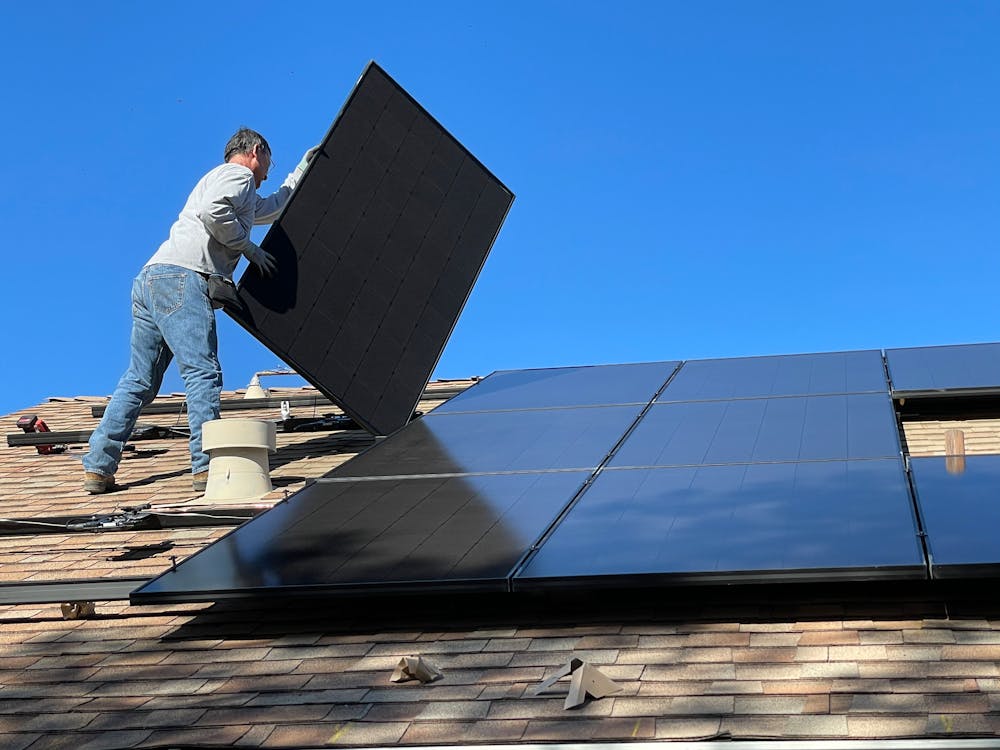
Photo by Kindel Media on Pexels
The banks tried green lending and walked away. Energy companies won't make the same mistake, because they're the only ones who can own the entire value chain.
Solar panel demand in the UK is up 182% year-on-year, according to data from renewable energy specialist Glow Green. Octopus Energy, the UK's largest energy supplier, reports a 50% surge in solar sales since the start of the Iran war, with heat pump inquiries up over a third. These aren't projections or policy aspirations. These are households voting with their wallets, right now.
The trigger is geopolitical, the Iran conflict has sent wholesale oil and gas prices climbing, and Ofgem's price cap is widely expected to rise again in July 2026. But the underlying trend is structural. Consumers learned the lesson of the Ukraine crisis: relying on volatile fossil fuel markets is a risk they can mitigate, and solar panels paired with battery storage are the most tangible way to do it.
The demand is here. But who is going to finance it, and who is going to capture the value when they do?
The Warm Homes Plan: Ambitious on Paper, Slow in Practice
The government's answer is the Warm Homes Plan, published in January 2026. On paper, it's transformative: £15 billion to upgrade five million homes by 2030, tripling rooftop solar installations from 1.6 million to 4.6 million homes, and hitting 450,000 heat pump installations per year by the end of the decade.
Critically, the plan includes a £1.7 billion consumer loan scheme offering low- and zero-interest finance for solar panels, batteries, and heat pumps. This is the government explicitly recognising that grants alone won't close the gap, consumer lending has to be part of the infrastructure.
But here's the problem: the loan scheme doesn't launch until April 2027. That's over a year away.
And even the plan's own targets are already showing signs of strain. The heat pump installation target has been quietly scaled back from 600,000 per year by 2028 to 450,000 by 2030. The longstanding proposal to ban new gas boiler installations beyond 2035 has been dropped entirely. Carbon Brief's analysis described the approach as "all carrot and no stick." Policy analyst Adam Bell has questioned whether the funding even stacks up against the planned installation numbers.
UK Heat Pump Installation Targets: The Shifting Goalposts
Annual installations (thousands), Original target vs. Warm Homes Plan (revised)
Sources: CCC Net Zero pathway; DESNZ Warm Homes Plan (January 2026); Carbon Brief analysis
None of this means the Warm Homes Plan won't work. It means it won't work fast enough, not for the households already searching for solar panels, and not for the energy companies watching a once-in-a-generation commercial opportunity form right in front of them.
The Cautionary Tale: Why Banks Couldn't Crack Green Lending
Before any energy company rushes to fill this gap, it's worth understanding why the last set of institutions to try green lending got burned.
Between 2011 and 2015, Barclays Partner Finance, along with Hitachi and Ikano Bank, provided consumer finance for residential solar panel installations. The model was straightforward: third-party installers would sell and fit the systems, while the banks provided the loans. Customers were told that electricity generation and feed-in tariff income would cover their monthly repayments. The systems would, in effect, pay for themselves.
They didn't.
Real-world performance fell dramatically short of the projections. Customers found themselves locked into loans for systems that couldn't generate enough energy to cover the repayments. The Financial Ombudsman received over 2,000 complaints. Barclays set aside £38.5 million to address claims. Several of the installation companies, including MyPlanet, went into administration.
The root cause wasn't that green lending is inherently risky. It's that the banks had no control over the value chain. They were financing installations carried out by third parties they couldn't vet, couldn't monitor, and couldn't hold accountable. Under Section 75 of the Consumer Credit Act, when a third-party fitter oversells or underdelivers, it's the lender, not the installer, left holding the liability. The banks were underwriting a product they couldn't see, sold by companies they couldn't control, to customers whose energy profiles they didn't understand.
That is a fundamentally different problem from the one energy companies face today.
Why Energy Companies Are Uniquely Positioned to Win
An energy company that chooses to offer green finance isn't lending blind. It already owns the customer relationship. It has years of consumption data, seasonal usage patterns, payment history, the precise energy profile of every household on its books. It understands what a solar installation or heat pump should save a specific customer, not based on a generic projection from a salesperson, but based on real data.
More importantly, an energy company willing to back its brand can own the entire value chain: the customer acquisition, the product recommendation, the installation, the financing, and the ongoing energy management. There is no third-party fitter to oversell. There is no information asymmetry between the lender and the installer. The brand is on every touchpoint, which means the incentive to get it right runs all the way through.
This is what the banks never had, and it's why they failed. The opportunity for energy companies isn't just to offer green lending, it's to do it in a way that structurally cannot repeat the mistakes of the past.
And the commercial case is compelling. Ofgem currently allows energy suppliers a maximum profit of roughly 2.5% per customer account, that works out to approximately £30 per customer on the current price cap. Aggregate domestic supplier profit dropped from £0.88 billion in 2024 to just £0.27 billion in 2025. Energy retail, even in a period of high prices, is a thin-margin business constrained by regulation.
Consumer lending operates in a different universe. The margins on well-underwritten green finance products, particularly when bundled with energy savings and supported by government-backed schemes, are multiples of what energy retail delivers. For an energy company serving millions of customers, the transition from energy supplier to energy-and-finance provider isn't a pivot. It's an upgrade to an entirely more profitable business model.
The Missing Piece: Lending-Grade Credit Infrastructure
There's a reason most energy companies haven't already launched green finance products, and it isn't lack of ambition. It's that lending is a regulated, complex discipline, and the infrastructure required to do it well, affordability assessment, credit decisioning, regulatory compliance, collections management, doesn't exist inside an energy business today.
The central equation in green lending is deceptively simple: if the monthly cost of financing a solar panel or heat pump installation is less than the energy savings it delivers, the customer is better off from day one. The loan doesn't feel like debt, it feels like a cheaper energy bill. That net-net benefit is what makes green finance fundamentally different from other consumer lending. But proving it, customer by customer, household by household, requires a level of energy-specific intelligence that traditional credit models simply don't have.
This is where Credit Canary changes the equation.
Credit Canary provides lending-grade data intelligence purpose-built for the energy sector. Its platform unifies energy consumption data, payment history, Open Banking transactions, and credit bureau data into a single customer view, then applies energy-specific affordability scorecards that don't just assess whether a customer can repay, but whether the installation will deliver savings that exceed the financing cost. That's the difference between a loan that burdens a household and one that genuinely reduces their cost of living.
For an energy company looking to launch green finance, this means:
The net-net, proven at the point of sale. Credit Canary's decisioning engine can model projected energy savings against financing costs for each individual household, using real consumption data, not generic industry averages. When the numbers show a customer will save more than they'll pay, you're not just approving a loan. You're approving a better outcome.
Origination at speed. Branded digital application journeys that can be embedded across direct channels, broker networks, and marketplace platforms, so you can go to market with a green lending product in weeks, not years.
Pre-arrears intelligence. AI-triggered interventions that identify customers at risk of payment difficulty before they miss a payment, drawing on energy-specific signals that a generic lending platform would never see.
Regulatory confidence. Automated compliance with full audit trails and data-driven identification of vulnerable customers, built for FCA-regulated lending from the ground up.
In practical terms, Credit Canary is the infrastructure layer that lets an energy company prove the net-net benefit of green finance at scale, and act as a lender without having to become a bank.
The 14-Month Head Start
The Warm Homes Plan's consumer loan scheme arrives in April 2027. That's fourteen months from now. The energy companies that launch private green finance before that date won't just capture early revenue, they'll build something far more valuable: data, operational muscle, and market credibility.
Every loan originated between now and April 2027 is a data point that sharpens affordability models and refines risk scoring. Every customer journey is a lesson in what converts, what stalls, and what drives repayment. Every successfully financed installation is a proof point that this model works, evidence that will matter enormously when the government's scheme arrives and energy companies are competing for a share of £1.7 billion in subsidised lending.
The companies that move now will be the ones that shape how the Warm Homes Plan loan scheme is delivered. They'll have the track record, the data, and the credibility to position themselves as the delivery partners of choice, not scrambling to build infrastructure while their competitors are already scaling.
History tells us what happens when the market waits for government. The Green Deal, launched in 2013 to improve home energy efficiency, was quietly scrapped in 2015 after issuing just 15,000 finance plans, with only around 10,000 homes actually receiving measures, against a target of millions. The gap between policy ambition and market readiness was too wide, and no one had invested in closing it early enough.
The Warm Homes Plan doesn't have to follow the same path. But it will need energy companies that have already proven they can lend responsibly, at scale, with the right infrastructure behind them. The programme's success depends on private sector readiness, and the companies that start building now will be the ones that make it work.
The Bottom Line
Solar demand is surging. Consumers are ready. The government has committed £15 billion but won't have its lending infrastructure live for another fourteen months. The banks tried green lending a decade ago, got burned by third parties they couldn't control, and left. Every condition is in place for energy companies willing to back their brand to own this market, from customer acquisition through to financing and installation.
The winners won't be the best energy suppliers. They'll be the energy companies that figured out lending first.
The question isn't whether this shift is coming. It's whether you'll be leading it or chasing it.